
Starting a project management career straight out of college can feel like standing at the base of a mountain you are not sure you are equipped to climb. Fresh graduates scroll through job listings that all seem to demand “3-5 years of experience,” and the frustration sets in: how do you get experience if nobody will hire you without it?
According to PMI research, businesses worldwide will need to fill more than 25 million project management positions by 2030; that’s roughly 2.3 million new jobs created every year across all industries. The Certified Associate in Project Management (CAPM®) exists precisely to help newcomers like you step into one of those roles, even when your resume is short on experience.
What CAPM® Actually Is (And Why It’s Built for Freshers)
CAPM® is PMI’s entry-level certification designed specifically for people starting their project management careers. Unlike the PMP®, which requires 36 months of project leadership experience, the CAPM® requires none.
What it does require is a secondary degree (high school diploma or associate’s degree) and 23 hours of project management education. That’s it. You can complete those 23 hours through affordable online CAPM Certification courses, PMI webinars, mostly for under $400 total.
The certification proves you understand the foundational language, processes, and frameworks that project managers use daily. You won’t have war stories from leading multi-million dollar projects yet, but you will understand how those projects should be structured and managed.
Five Ways CAPM® Opens Doors for Fresh Graduates
1. It Signals You are Serious (Not Just Curious)
Hiring managers see hundreds of resumes from recent graduates who claim they are “interested in project management.” Most never back that claim with action.
When you list CAPM® on your resume, you are proving you invested time, money, and effort to learn this profession. You studied scope management, stakeholder analysis, risk assessment, and Agile principles. That’s not curiosity; that’s commitment.
CAPM-certified graduate experience from public forum Reddit: “The certification was exactly what I needed to get started. I was new to project management and didn’t understand the language, the processes, or the knowledge areas. It was the perfect foundation.”
2. It Makes Your Resume Visible to Recruiters
Many companies use Applicant Tracking Systems (ATS) that scan resumes for specific keywords. “CAPM” is one of those keywords, especially for entry-level roles like:
- Project Coordinator
- PMO Analyst
- Project Administrator
- Associate Project Manager
Without the certification, your resume might never reach human eyes, even if you are qualified in other ways. With CAPM®, you pass that first digital gatekeeper.
Forbes reports that CAPM-certified project managers in the United States earn an average salary of $70,000, a solid starting point for someone straight out of college.
3. It Teaches You to Think Like a Project Manager
Here’s what the CAPM® study actually involves: learning to break complex work into manageable phases, identify risks before they become problems, communicate across different stakeholder groups, and balance competing constraints like time, cost, and quality.
These aren’t abstract concepts. They are practical thinking skills that apply immediately, whether you are coordinating a product launch, managing a software rollout, or organizing a departmental reorganization.
Industries like IT, healthcare, construction, and education all actively hire CAPM-certified candidates because project management principles cross industry boundaries.
4. It Creates a Clear Path Forward
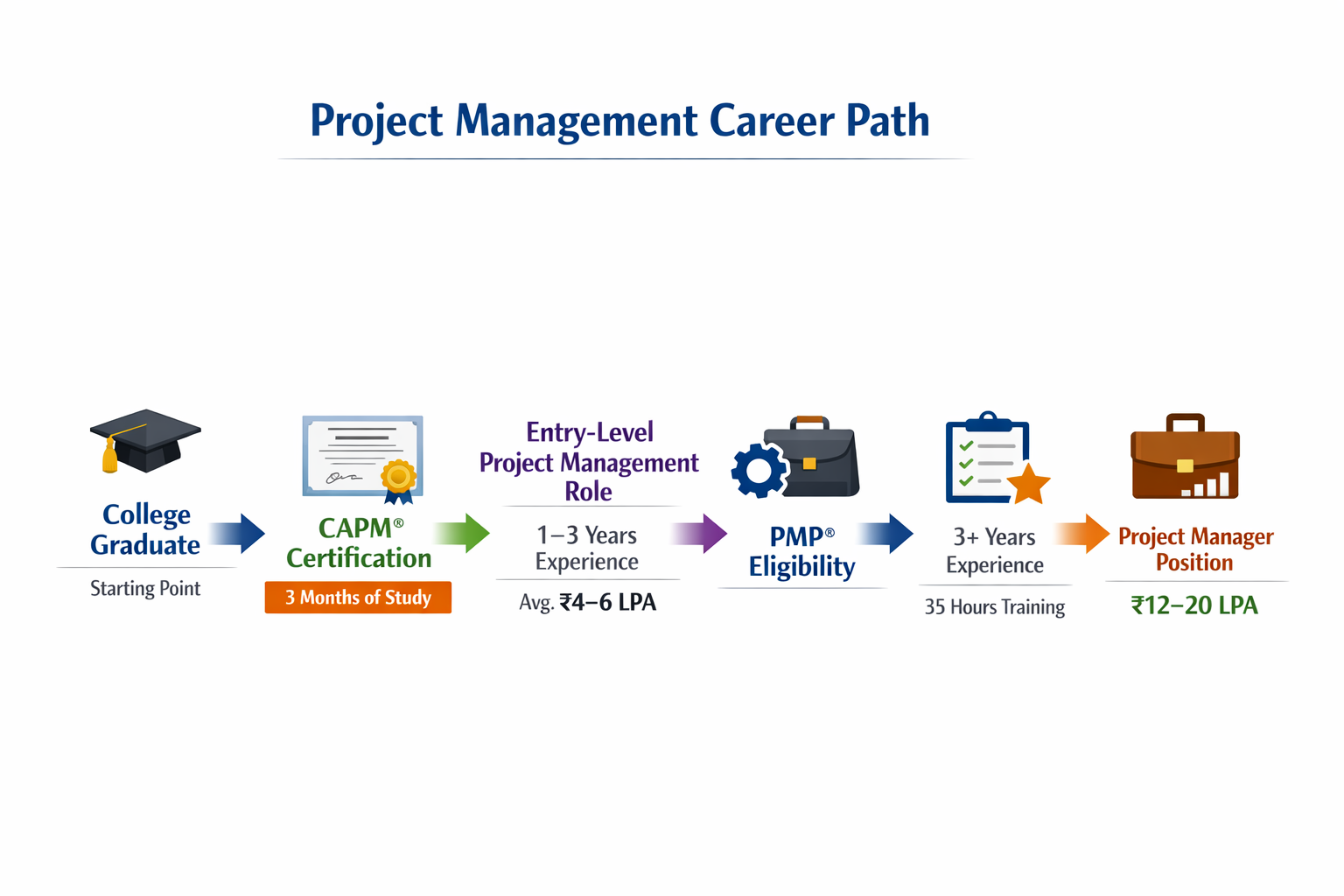
CAPM® isn’t the destination; it’s the starting line. Once you have worked in project coordination roles for 36 months and accumulated enough experience, you become eligible for the PMP®.
That progression looks like this:
CAPM® → Entry-level role → 3 years experience → PMP® → Senior PM roles
Without CAPM®, many graduates spend years in generic administrative roles that don’t build relevant PM experience, making the eventual jump to project management much harder.
5. It Connects You to a Professional Community
Your CAPM® certification grants access to PMI’s global network; local chapters, online forums, webinars, conferences, and job boards. This isn’t minor. Many CAPM holders found their first roles through PMI chapter volunteer opportunities or networking events.
“PMI chapters mostly have volunteer opportunities for CAPM holders. These projects provide hands-on experience in planning, scheduling, and stakeholder engagement; exactly what you need to build your resume.”
Bridging the Experience Gap (Because That’s the Real Challenge)
Let’s address the gap bridge: most entry-level PM jobs still ask for “1-3 years of experience.” How do you handle that?
Reframe your college experience
That senior capstone project where you coordinated team deliverables? That was scope and time management. The club event you organized with a $2,000 budget? Resource and cost management. Document these using PM terminology.
Pursue strategic internships
Target companies with formal PMO structures. Large financial services firms, tech companies, and healthcare organizations mostly have entry-level PM roles specifically designed for CAPM-certified candidates.
Volunteer strategically
Nonprofits, PMI chapters, and community organizations constantly need project help. Volunteer to support (not lead; yet) an actual project. Even 3-6 months of documented volunteer PM work strengthens your resume significantly.
One guy who transitioned from retail management noted in Reddit: “I had no formal PM experience, but I described all my previous roles in the context of what a competent project manager would have done: communication, quality control, planning, execution. That reframing, combined with CAPM®, got me interviews.”
The Honest Reality Check
CAPM® won’t hand you a Project Manager title on day one. What it will do is qualify you for Project Coordinator, PMO Analyst, or Associate PM roles; positions that generally pay $40,000-$60,000 and provide the hands-on experience needed to advance.
According to PMI, CAPM® is ranked #1 in Entrepreneur Media’s list of “The 9 Most In-Demand Professional Certifications.” But the certification alone isn’t magic. You still need to apply strategically, network actively, and continuously build your skills.
Conclusion: Your Next Step
If you are a fresh graduate wondering how to break into project management, CAPM® offers the clearest, most affordable pathway. It costs less than most professional courses, requires no prior experience, and opens doors that would otherwise remain closed.
Start with the 23 hours of education. If the material resonates, if you find yourself thinking “this makes sense, I could apply this,” schedule the exam. Within 3-6 months, you could have a globally recognized certification and a legitimate shot at your first project management role.
The 25 million jobs aren’t waiting forever. Get started.

Be First to Comment